
Guides
Neighbours playing loud music: how to document
Music, bass, parties – how to record your neighbours' loud music factually, why bass is disturbing in a different way and how to prepare the conversation.
If your neighbours play loud music, the best way to document it is with the time, duration, type of music (above all: bass or no bass), the room where you hear it and the impact. Because bass travels through walls and ceilings and is underestimated by dB(A) readings, it belongs explicitly in your diary. With a few weeks of records you can have a specific conversation or contact the property management.
What to note when music is the problem
| Detail | How to describe it (fictitious) |
|---|---|
| Time, duration | Sat 15 Mar, 23:30 – 01:10 (100 min) |
| Type | Music with heavy bass, vocals barely audible |
| Room | Bedroom, even with the window closed |
| Other sounds | Voices, laughter, chairs scraping from 00:30 |
| Impact | did not fall asleep |
| Reading (optional) | 52 dB(A), phone, guide value |
Distinguish between a single party and regular loud music. Both can be disturbing, but the way you deal with them differs.
Why bass is particularly disturbing
Low sounds pass through walls and ceilings more easily than high ones. What is music in the room next door often reaches you only as the dull thump of the bass.
For measurements, this means: dB(A) gives less weight to low frequencies. A smartphone therefore often shows low values for bass, even though the noise is clearly disturbing. In such cases, write “bass” or “dull thumping” explicitly in your diary – here the description says more than the number. More on this in How accurate is a phone decibel meter?
A single party or an ongoing problem?
| Situation | Sensible step |
|---|---|
| Single party, announced in advance | usually put up with it or mention it briefly |
| Single party, very late and very loud | note the time; for an acute, serious disturbance, depending on where you live, the police or the local authority |
| Regular loud music, especially in the evening | a diary over several weeks, then a conversation |
| Conversation unsuccessful | report to your landlord or the property management with your diary |
Preparing the conversation
- Two or three examples with date and time are enough.
- Mention the bass: “I can barely hear the music itself, but the bass is clearly noticeable in my bedroom.”
- Suggest simple solutions: turn down the bass on the amplifier, keep speakers away from the shared wall, quieter after a certain time.
- Stay calm and write down what you agree.
Recording music automatically
Noise Diary creates a noise event with the time, duration, peak and average level every time your logging limit is exceeded – even at night with the screen off. On the noise event you choose the category Music / bass and add what could be heard.
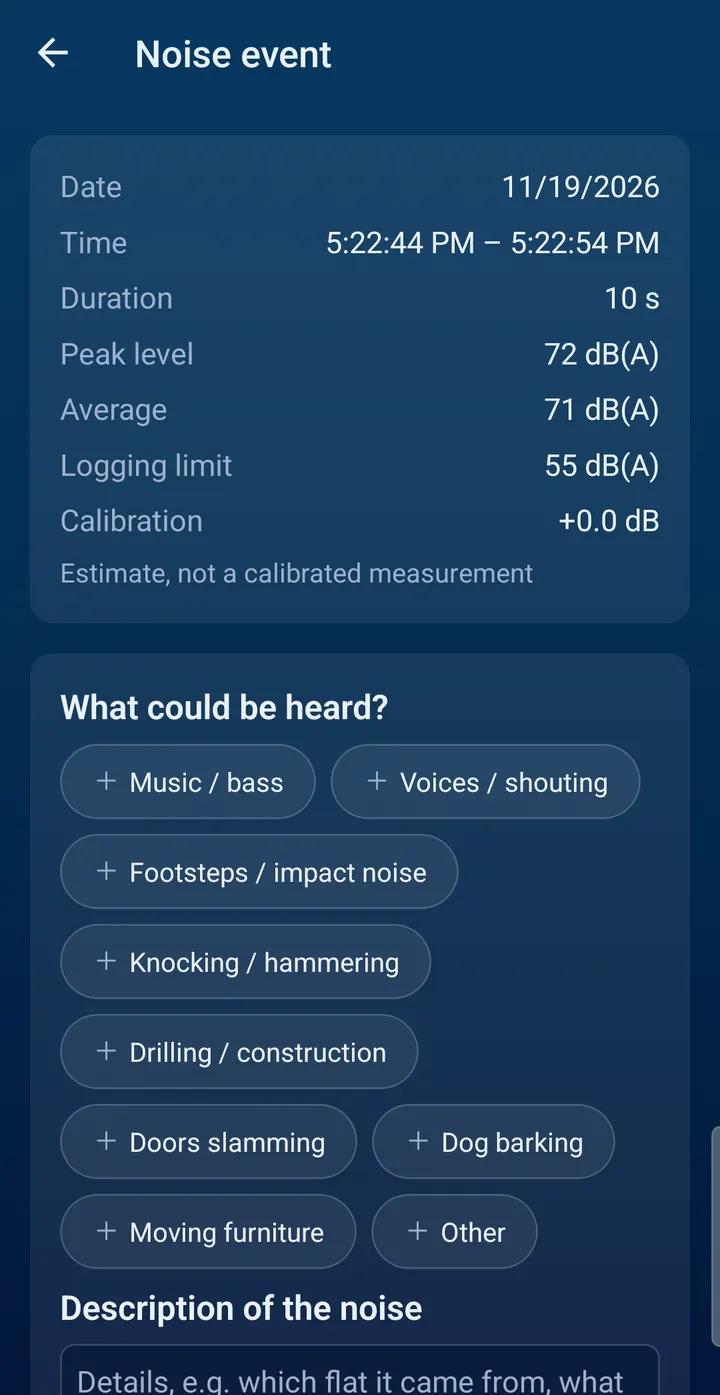
Set the logging limit just above the background level of your room, so that bass with a low dB(A) value is captured too. The app cannot tell where the music comes from; the levels are guide values. Noise Diary is not in the app stores yet – sign up here to be notified.
Further guides
Frequently asked questions
Why does my phone only show low readings for bass?
dB(A) gives less weight to low sounds, much like human hearing at moderate volumes. Bass can therefore be clearly disturbing even though the value shown is fairly low. Mention the bass explicitly in your diary.
Is a single party a reason to complain?
A single party is often best raised directly with your neighbours. For a report to your landlord or property management, a diary covering several weeks is usually more helpful, because it shows whether the disturbance recurs.
When is music too loud?
There is no general answer; it depends on the time of day, duration, volume and the applicable law. A diary with times and their impact helps you describe the situation factually.
What can I do about loud music in the middle of the night?
Note the time and duration. For an acute, serious disturbance, depending on where you live, the police or the local authority are responsible. The next day you can try talking to your neighbours.
Note: smartphone readings are indicative and do not replace a professional assessment.
This guide is general information, not legal advice.
Noise Diary is coming to Android first, iOS later. Sign up and we will email you as soon as the app is in the store for your platform. The templates and guides stay free to use without signing up.
Notify me
Get an email as soon as Noise Diary is available on Google Play or the App Store. This is not a user account – you use the app without signing in.
Related articles
Noisy neighbours at night: what to do
What you can do yourself during the night, how to follow up the next day and why a noise diary helps – step by step.
Noisy neighbours? How to document the noise
Music, footsteps, knocking or barking – how to record neighbour noise factually, prepare for a conversation and know who you can turn to.
How accurate is a phone decibel meter?
Smartphones show sound levels as a guide value. What dB(A), peak level and average mean, where the limits lie and how to take comparable measurements.